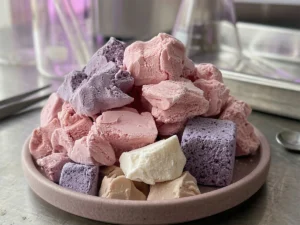
Picture this: You are standing in front of the majestic Yellow Crane Tower in Wuhan, China. The summer sun is blazing, and the humidity is thick enough to slice with a butter knife. You are desperately in need of a cold treat to beat the heat. But when you walk up to the nearest concession stand, you don’t reach for a boring, cylindrical vanilla popsicle, nor do you settle for a plain scoop of chocolate. No, you reach for a miniature, hyper-detailed, perfectly to-scale replica of the Yellow Crane Tower itself, cast entirely in frozen, brightly colored ice cream.
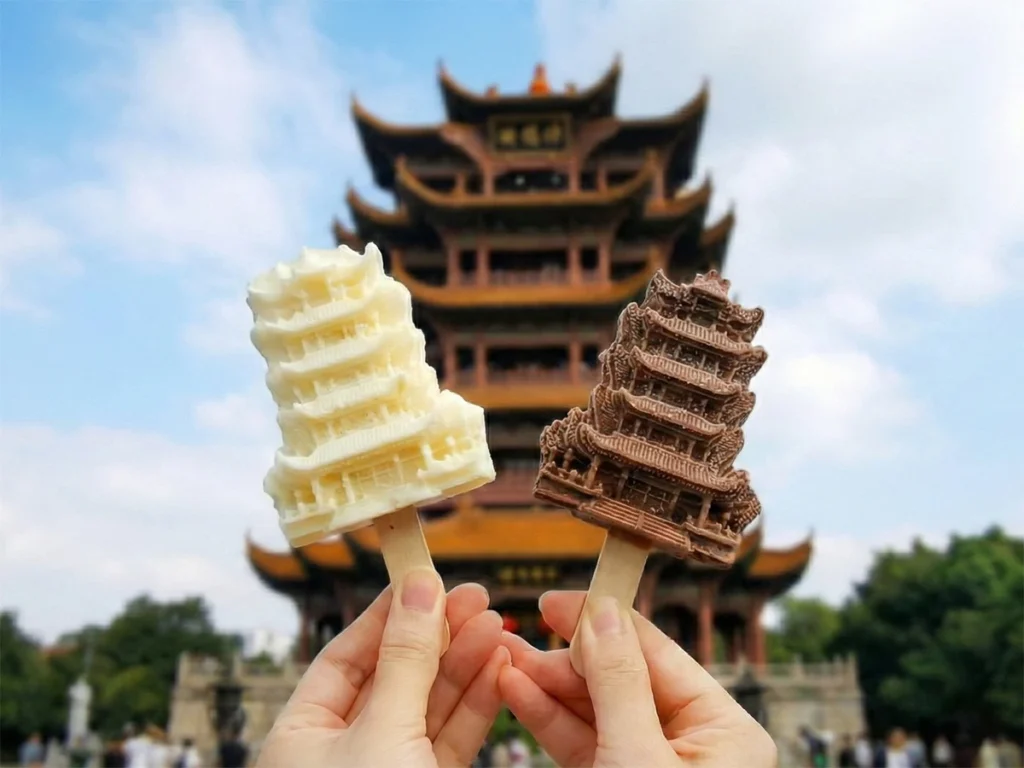
You carefully unwrap it, hold your edible architecture up against the real-life tower so they align perfectly in the frame, snap a picture, and immediately post it to your followers. Congratulations! You have just participated in one of China’s most delightful, photogenic, and booming summer trends: Cultural Creative Ice Cream (文创雪糕).
Over the past few years, tourist sites across China have started offering these customized frozen treats. You can munch on the Terracotta Warriors in Xi’an, take a bite out of the Great Wall of China in Beijing, or enjoy an intricately designed jacaranda flower in Kunming. The flavors are just as wildly diverse as the shapes, ranging from classic strawberry and chocolate to tiramisu, peony, and even herbal traditional Chinese medicine infusions.
But if you travel to Paris, London, or Rome, you will quickly notice a glaring absence. You cannot buy a neon-blue Eiffel Tower popsicle. There is no intricately molded Rosetta Stone ice cream at the British Museum. The Colosseum is completely devoid of gladiator-shaped sorbets.
Why is this incredibly fun, highly lucrative product an absolute sensation in China, but completely non-existent in the Western world? And more importantly, will we ever see a day where we can eat the Statue of Liberty on a stick? Let’s dive into the fascinating intersection of dessert, culture, and social media.
The “Daka” Phenomenon: Eating Your Way Through History
To understand why these incredibly detailed ice creams exploded in China, you have to understand the modern Chinese tourist—specifically, Gen Z and Millennials. For these younger generations, traveling is inextricably linked to “Daka” (打卡) culture.
Originally, “daka” simply meant “punching the card” or clocking into work. Today, it has evolved into a massive social phenomenon that means checking in at a trendy, viral spot and proving you were there by posting a highly curated photo or video on social media apps like Xiaohongshu (China’s lifestyle equivalent to Instagram) or Douyin (TikTok).
When you have limited time off to travel, the goal is often to “punch” as many destination cards as possible. And what better way to prove you visited a historic site than holding a beautifully crafted, 3D ice cream replica of it right in front of the actual landmark? The ice cream becomes the ultimate aesthetic prop. It transforms a standard, boring selfie into a playful, engaging piece of user-generated content that algorithms love to push to the top of everyone’s feed.
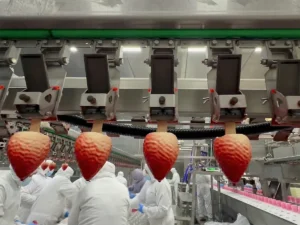
Furthermore, there is a deep sense of cultural pride at play here. These ice creams take ancient, sometimes intimidating historical artifacts and make them accessible, cute, and consumable. It connects the younger generation to their heritage in a way that feels fresh and modern. Add to that China’s incredibly agile manufacturing sector—which can quickly and cheaply design and produce complex silicone molds for these ice creams—and you have the perfect recipe for a nationwide dessert craze.
Why Europe and America Said ‘Pass’ to Popsicle Monuments
So, why hasn’t this brilliant idea crossed the ocean? If tourists love taking photos in front of the Louvre or the Colosseum, wouldn’t they love a matching ice cream? As it turns out, the Western market is a totally different beast, hampered by strict culinary traditions, corporate bureaucracy, cultural perceptions, and environmental laws.
The Gelato Dilemma: Taste vs. Aesthetics
If you are wandering the streets of Rome or Paris, you are in the heartland of serious ice cream culture. In Europe, the gold standard of frozen treats is gelato. But gelato and 3D-molded popsicles are fundamentally incompatible from a scientific standpoint.
Gelato is famous for its dense, velvety texture, which is achieved by churning it very slowly to incorporate as little air (overrun) as possible. Furthermore, authentic gelato is served at a slightly warmer temperature than traditional hard ice cream—usually around 10 to 22°F—so that it is soft, elastic, and intensely flavorful.
This soft, melty consistency is an absolute nightmare for 3D molding. If you try to freeze gelato into the shape of a Gothic cathedral, those sharp, beautiful architectural details will quickly turn into a sad, drooping puddle the second it hits the summer air. To make an ice cream that holds sharp, 3D shapes for several minutes while tourists fiddle with their camera angles, you have to change the recipe. You need a harder, icier consistency, often with more stabilizers or a higher water content.
To a European palate, this is practically a culinary crime. Europeans heavily prefer their ice cream scooped fresh into a cup or a buttery cone. They want a luxurious, indulgent mouthfeel. Handing a French or Italian tourist a rock-hard, artificially colored block of ice on a stick just so it looks like a museum exhibit would be seen as a massive downgrade in quality. For them, taste and texture will always reign supreme over visual novelty.
The Bureaucracy of the Museum Gift Shop
Another massive hurdle is the way Western museums operate their food services. If a historical park in China wants to sell a custom ice cream, they usually have the administrative agility to just hire a local manufacturer and get it done.
In the West, however, the cafes and concession stands at major museums are rarely run by the museums themselves. Instead, they are outsourced to massive, multinational foodservice conglomerates like Sodexo, Aramark, or Compass Group. These giants feed millions of people across stadiums, universities, and museums every single day, and their entire business model is built on economies of scale.
These companies want standardization. It is infinitely cheaper and easier for them to stock the exact same premium Magnum bars, Haagen-Dazs tubs, or Nestle cones at the Louvre as they do at a corporate cafeteria. Designing a custom mold, sourcing a specific manufacturer for a low-volume run, and dealing with the logistical nightmare of shipping fragile, 3D ice creams to a single museum location is simply not worth the hassle or the cost for these massive operators.
The “Kitsch” Factor
There is also a subtle cultural divide in how we view historical monuments. In China, modernizing and “cute-ifying” history is wildly popular and viewed as an innovative way to celebrate the past.
In Western Europe, however, there is a thin line between “fun souvenir” and “tacky kitsch.” Selling a bright pink, strawberry-flavored replica of the Rosetta Stone or a neon-green Parthenon might be viewed by elite cultural institutions as a cheapening of world history. Western museum gift shops have recently been leaning hard into sustainability, wellness, and high-end minimalism. They would much rather sell you an ethically sourced, locally handwoven scarf or a beautifully bound coffee table book than a goofy, sugary caricature of their most prized artifacts.
Red Tape, Plastics, and Neon Dyes
Even if a European museum desperately wanted to sell these treats, the European Union’s regulatory rulebook would make it incredibly difficult.
Intricate 3D ice creams are fragile. To survive the journey from the factory to the museum freezer, they usually require sturdy, custom-molded plastic blister packs. The EU, however, is waging an absolute war on single-use plastics. Between the Single-Use Plastics (SUP) Directive and the sweeping Packaging and Packaging Waste Regulation (PPWR), putting a single ice cream bar inside a giant, non-reusable plastic clamshell is quickly becoming a regulatory and public relations nightmare. By 2030, the EU mandates that packaging must be recyclable and drastically reduced in volume. Sustainable alternatives, like paper or molded fiber, simply don’t offer the transparency or structural support needed to show off and protect a 3D ice cream.
Then there is the issue of color. Chinese cultural ice creams are often spectacularly vibrant, relying on food dyes to achieve bright pinks, blues, and greens. The EU has incredibly strict regulations on artificial food coloring, requiring intimidating warning labels on products containing certain synthetic dyes, stating they may have an adverse effect on activity and attention in children. Good luck selling a fun family treat that carries a warning label! Trying to achieve those same eye-popping neon colors with natural, plant-based dyes is notoriously difficult, expensive, and unstable.
Will the West Ever Bite? The Future of Novelty Desserts
So, does this mean the West will never get to enjoy the thrill of highly aesthetic, Instagrammable frozen treats? Not exactly. The desire to post beautiful food online is a universal human trait. The West is definitely jumping on the visual food bandwagon, but they are doing it in their own unique way.
Instead of mass-produced tourist souvenirs, the Western market is leaning toward “luxury edible art.” Take the viral sensation of French pastry chef Cédric Grolet, for example. He has taken the internet by storm with his “trompe l’oeil” (optical illusion) desserts. People will gladly stand in line for hours in Paris or London to pay top dollar for a dessert that looks exactly, flawlessly like a real lemon or a hazelnut. This proves that Western consumers absolutely love 3D, photorealistic food—they just want it elevated to the level of high-end gastronomy rather than a simple popsicle.
Theme parks are also paving the way. Disney has built an absolute empire on food shaped like Mickey Mouse, proving that character-driven novelty treats work brilliantly in immersive environments. Over at Universal Studios, the Wizarding World of Harry Potter recently rolled out a Butterbeer Ice Lolly. Interestingly, this treat features a highly detailed, molded hard chocolate shell that encases a softer popsicle inside.
This “hard shell, soft core” technology might actually be the golden ticket for bringing 3D ice cream to the West. By using a thick, molded chocolate shell on the outside, manufacturers can achieve incredibly sharp, beautiful 3D details that won’t melt instantly in the sun. Meanwhile, the inside can be filled with the rich, soft, indulgent gelato that European and American consumers demand.
Add in the viral power of TikTok, and this concept is a guaranteed goldmine. Right now, social media is obsessed with food textures and ASMR (Autonomous Sensory Meridian Response). Videos of people cracking the hard chocolate shells of “cracking lattes” or satisfyingly snapping into chocolate-covered strawberries are generating millions of views. Imagine a beautifully sculpted, 3D chocolate shell of a famous landmark that you can proudly photograph, before loudly and satisfyingly cracking it open to reveal a core of premium, pistachio gelato. It satisfies the need for visual “Daka” culture, the demand for high-quality taste, and the internet’s obsession with satisfying sounds all at once.
The Sweet Conclusion
The cultural creative ice cream trend is a perfect reflection of modern Chinese tourism: it’s fast, highly aesthetic, technologically impressive, and deeply connected to digital social currency. While the West’s strict food regulations, outsourced museum catering, and deep-seated loyalties to traditional gelato have kept the trend at bay for now, the universal language of “camera eats first” cannot be ignored.
We may never see a cheap, neon-colored sugar popsicle being sold at the foot of the Eiffel Tower. But as food technology advances and the line between pastry chefs and sculptors continues to blur, it is only a matter of time before European and American destinations find their own way to let us have our history, and eat it too. Until that day comes, we will just have to keep scrolling through social media, watching from afar as tourists across the globe take a delicious bite out of antiquity.