Imagine this: you’re deep in the wilderness on a three-day trek, miles from the nearest convenience store, and the sun is beating down on your shoulders. You reach into your pack and pull out a slice of Neapolitan ice cream. It hasn’t melted. It isn’t sticky. In fact, it’s perfectly crisp, lightweight, and tastes exactly like your favorite childhood sundae.
Welcome to the world of freeze dried ice cream.
Once a niche novelty found exclusively in science museum gift shops, this “space food” is currently undergoing a massive commercial renaissance. By 2025, the global market for freeze-dried ice cream is estimated to reach approximately $540 million, with projections suggesting it could hit $1.1 billion by 2033. Whether you call it astronaut ice cream, space treats, or simply the most satisfying crunch on the planet, there is no denying that this dehydrated delight is a heavy hitter in the modern snack industry.
In this deep dive, we’ll explore the science, the myths, and the booming market trends that are making freeze dried ice cream a staple for hikers, space enthusiasts, and foodies alike.
The Science of the Crunch: How Is It Made?
The secret behind the “unmeltable” nature of freeze dried ice cream lies in a process called lyophilization. Unlike traditional dehydration, which uses heat to evaporate water and can often toughen the food lyophilization uses extreme cold and vacuum pressure to remove moisture through sublimation.
The Three Stages of Sublimation
- The Freezing Phase: The ice cream is deep-frozen to temperatures between -20 ℉ and -30℉. This solidifies all the water content into ice crystals.
- Primary Drying (Sublimation): Inside a vacuum chamber, the pressure is lowered below the “triple point” of water. A small amount of heat is applied, causing the ice to turn directly into water vapor without ever becoming a liquid. This stage removes about 90-95% of the moisture.
- Secondary Drying (Desorption): The temperature is slightly raised to remove any remaining “bound” water molecules. By the end of the process, roughly 98% of the original water content is gone.
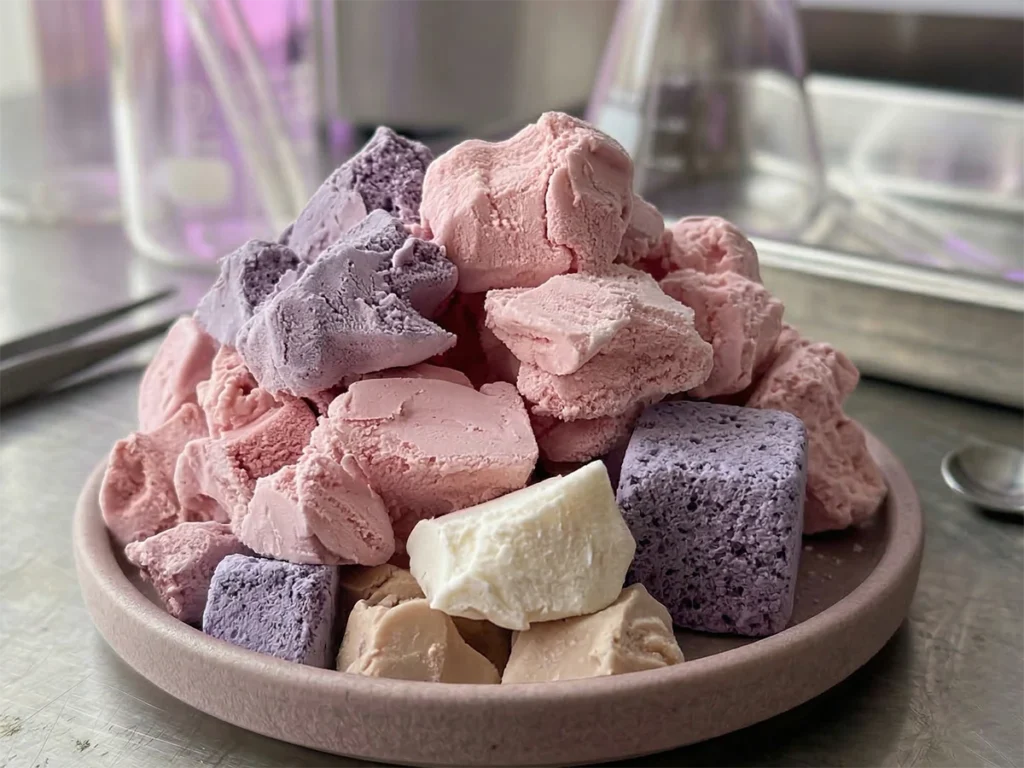
What’s left is a porous, rigid “skeleton” of the original ice cream. Because the structure remains intact, it retains the exact flavor and nutritional profile of the original dessert, just without the drip.
The NASA Connection: Myth vs. Reality
If you ask anyone about freeze dried ice cream, the first word out of their mouth is usually “Astronauts.” The association with the Space Age is the core of its marketing, but the actual history is a bit more complicated—and a lot crunchier.
The popular legend says that astronauts have been munching on these blocks since the 1960s. The truth? It likely only flew once. Records show that “vanilla ice cream” was listed on the menu for the Apollo 7 mission in 1968. However, the only surviving member of that crew, Walt Cunningham, later noted that they “never had any of that stuff”.
The problem wasn’t the taste; it was the physics. In microgravity, the brittle, chalky texture of freeze dried ice cream is a hazard. “How could we have something up here that crumbled and crunched?” explained astronaut Chris Hadfield. “It would get in my eyes. We’d breathe it. There would be crumbs floating everywhere,” potentially interfering with sensitive spacecraft instruments.
Today’s astronauts actually get the real thing. Since the International Space Station is equipped with freezers for scientific experiments, NASA often “borrows” a little space to send up cups of Blue Bell vanilla or chocolate. So, while it’s still the ultimate “Space Treat” for us on Earth, it’s mostly a gift-shop legend in orbit.
Market Overview: A Billion-Dollar Industry
The demand for freeze dried ice cream is no longer just about nostalgia. It has found a massive audience in three specific sectors: outdoor recreation, emergency preparedness, and the “clean label” snack movement.
The King of the Trail
Outdoor enthusiasts (hikers, campers, and backpackers) account for an estimated 35% of total market revenue, exceeding $175 million annually. When you’re carrying everything on your back, weight is your worst enemy. Because freeze-drying removes 90% of the weight (the water), a full serving of ice cream weighs only a fraction of an ounce.
Regional Dominance and Growth
- North America: Currently dominates the market with a 40% global share, driven by a well-established outdoor culture and high disposable income.
- Asia-Pacific: This is the fastest-growing region. In China, the freeze-dried food market surged to 3.8 billion RMB in 2024.[6] Brands like Three Squirrels and Be & Cheery are rapidly incorporating freeze-dried dairy into their snack portfolios.
- Europe: Seeing significant growth as “specialty and artisanal” freeze-dried products gain traction among urban consumers.
The Digital Surge
The way we buy freeze dried ice cream has shifted. Online sales are projected to outpace traditional retail channels, with a projected revenue of $100 million in the coming years. Platforms like TikTok Shop have become a “phenomenon” for freeze-dried startups, where the visual “crunch” of the product is perfect for viral video content.
Product Features: Why Do People Love It?
If you haven’t tried it yet, the experience of eating freeze dried ice cream is hard to describe. It’s a sensory journey that traditional ice cream can’t replicate.
- The Texture: It feels like a light, airy cracker or a piece of honeycomb toffee. But the moment it touches your tongue, it rehydrates and turns back into creamy, smooth ice cream.
- Intense Flavor: Because the water is removed, the sugars and flavor compounds are highly concentrated. Many consumers report that the flavor feels “enhanced” or “hella strong” compared to the original version.
- No Brain Freeze: Since it’s stored at room temperature, you get all the satisfaction of ice cream without the painful temperature shock to your teeth.
- Shelf Stability: This is the game-changer. While a pint of Häagen-Dazs lasts maybe 15 minutes on a kitchen counter, a Mylar bag of freeze dried ice cream can be shelf-stable for up to 25 years.
Case Studies: Brands Leading the Charge
To understand the diversity of this market, let’s look at three very different companies making waves in 2025.
Case Study A: Astronaut Foods (The Heritage Brand)
Founded by Ron Smith in 1974 after a request from the Goddard Air and Space Museum, this brand is the original “Space Age” snack.
- Strategy: They lean heavily into nostalgia. Their Neapolitan slices are the gold standard for science museums globally.
- Innovation: Recognizing that the market is evolving, they’ve expanded into freeze dried ice cream sandwiches, “banana split” bundles, and even freeze-dried fruit and pizza.
Case Study B: Backpacker’s Pantry (The Performance Brand)
While Astronaut Foods handles the gift shops, Backpacker’s Pantry focuses on the rugged adventurer.
- Product: They focus on high-calorie, lightweight fuel. Their ice cream is designed to be a “moral booster” for people climbing 14,000-foot peaks.
- Key Advantage: Their packaging is optimized for durability and long-term storage, ensuring the product doesn’t turn into a bag of dust during a rough hike.
Case Study C: Coco (The Niche Innovator)
A newer player in the market, Coco is a Black-owned, woman-owned business focusing on vegan and non-dairy options.
- Market Gap: Founders Pierce and Katie Freelon noticed a lack of dairy-free options for lactose-intolerant kids visiting science museums.
- Flavor Profile: They offer sophisticated, gourmet flavors like “Vanilla Cardamom” and “Sweet Potato Pie,” proving that freeze dried ice cream can be a premium, inclusive experience.
Future Trends: What’s Next for 2026?
As we look toward 2026, the industry is moving away from the simple “vanilla brick.”
- Global Flavor Fusion: Expect to see ube, miso caramel, matcha, and Mexican horchata flavors entering the freeze-dried space.
- Functional Fortification: Brands are starting to add probiotics, protein (up to 30-40g per pint), and vitamins to freeze-dried bases, turning them from “guilt-treats” into functional snacks.
- Sustainable Tech: Energy consumption is a major hurdle, with a medium-sized dryer using about 18.5 kWh per cycle. Future innovations are focused on “variable speed drives” and energy-efficient heat exchangers to reduce the carbon footprint of production.
Freeze dried ice cream is a triumph of human ingenuity. It’s a product that shouldn’t exist—a frozen dessert that isn’t cold and doesn’t melt—yet it has captured our imaginations for over 50 years.
Whether you’re a backpacker looking for a lightweight summit treat, a parent looking for a mess-free snack for the car, or just someone who loves the satisfying “crunch” of a viral TikTok food trend, freeze dried ice cream offers a unique intersection of science and sweetness. As the market nears the $1 billion mark, it’s clear that our love for this “space treat” is anything but a passing phase.
So next time you’re at a museum or browsing your favorite outdoor store, grab a pouch. It’s more than just a snack; it’s a taste of the stars—delivered with a crunch.